
Problem Solved
Cases in this category focus on how CI has been used to accelerate problem solving in a specific domain.
CI How-to
Cases in this category highlight one specific design decision.
Task Performed
Cases in this category focus on a specific type of task 'the crowd' performs.
Kind of Collaboration
Cases in this category illustrate a specific kind of group work -- crowdsourcing, collaboration or co-design.
Level of Institutionalization
Cases in this category illustrate a specific level or type of institutionalization -- low to high and 'viral' (achieved success at scale).
Project website
Name: Sustainable Neighborhoods Program
Topic: Sustainability
Location: Lakewood, Colorado, United States
Implementation Level: city
Owner: City of Lakewood
Years in operation: 2010 - present
Platforms: sustainableneighborhoodnetwork.org website; In-person
Contact Information: Jonathan Wachtel, Sustainability Manager, Lakewood, CO
Contact Email: [email protected]
Alyssa Vogan, Sustainability Planner – Community Focus [email protected]
CASE STUDY LAST UPDATED: March 2021
When elected officials and city staff in Lakewood, Colorado, a mid-sized suburb of Denver, wanted to pursue sustainability goals, rather than relying on scarce city resources, they enlisted residents’ help and created a community-based sustainability “workforce.” To help the City achieve its sustainability goals, the city has created a way for citizens to design, run and implement their own sustainability projects.
Previously, the city worked with residents in the usual way through planning system processes that left people with little opportunity to contribute once decisions had been made. Typically, residents could come to a planning meeting to offer feedback about plans already-made or channel ideas through a part-time neighborhood planning officer but this left the planner overwhelmed and residents frustrated.
The city’s planner Jonathan Wachtel changed this by introducing the Sustainable Neighborhoods Program in 2010. The program encourages residents with passion, ideas, and know-how to propose projects that they will develop and implement with neighbors. As Wachtel explains, he wanted to change how he worked because “a lot of people had interest and expertise...all the inquiries around green topics kept getting directed my way...I was getting tired of not being able to say anything except thank you.” Given the libertarian and free-spirited culture of Colorado, the Mayor wanted to make sure that the project didn’t tell citizens what to do but, instead, allowed them to self-select to participate and design their own projects.
The city supports neighborhood projects with technical advice, leadership coaching, and help to secure grants and to navigate city bureaucracy. It is an approach that enables the city to invest in feasible and impactful proposals by working with enthusiastic residents on projects capable of making a significant contribution to the city’s sustainability goals. For example, residents in the neighborhood of Morse Park have a tree planting initiative with a goal to plant 200 new trees on private residential properties by the end of 2020. To date, 120 residents have planted 134 trees, which is contributing to the city’s target of 30 percent tree canopy coverage by 2025.1 After the initial pilot in 2010, the full program was rolled out in 2012 and now includes eight neighborhoods covering 20 percent of the city population.
The result? Residents have led the delivery of more than 500 projects, events and workshops since the full program began in 2012. Among these are projects that have reduced waste, conserved water and improved energy efficiency. In all, 20,952 residents have participated in various events such as sustainability workshops, regular “sustainability club” meetings, and special events such as neighborhood clean ups that generate collective action from residents.2 Many more have made specific contributions to individual neighborhood projects. The program has helped to build support for a city-wide sustainability plan and neighborhood projects can now be aligned with targets in the plan.
Now, instead of City Planner, Wachtel is called the City’s Sustainability Manager and he oversees a team of two full time planners, a part-time manager of the Sustainable Neighborhoods Program and two interns who work 1-1-5 hours per week.
Wachtel explains that the program also strengthens positive interactions between residents and the city administration. When people learn projects are part of the program and resident-driven their suspicion about the city’s involvement dissipates, while elected officials and city staff recognize residents from Sustainable Neighborhoods as valuable contributors to city goals.
Nearby cities have adopted the program and Lakewood officials have established an umbrella initiative (and are hoping to create an entity) - the Sustainable Neighborhood Network - to support uptake and share ideas across participating neighborhoods.
How does it work?
Neighborhoods are invited to submit applications to join the program. Plans are assessed against criteria that consider the suitability of proposed projects for the neighborhood, how wider resident participation will be encouraged, and how projects address equity and diversity. As Wachtel points out, “the biggest challenge is diversity. We depend on people to volunteer and we don’t see as much equity as we would like in terms of who is leading the programs.”
When an application is approved, the program coordinator makes contact to help get projects off the ground. Through a dedicated program website neighborhoods can track their projects and share news. Approved and completed projects earn credits awarded by the city. When a neighborhood reaches 60 credits they are certified as a Sustainable Neighborhood. To maintain that status beyond one year neighborhoods must continue to participate in the program.
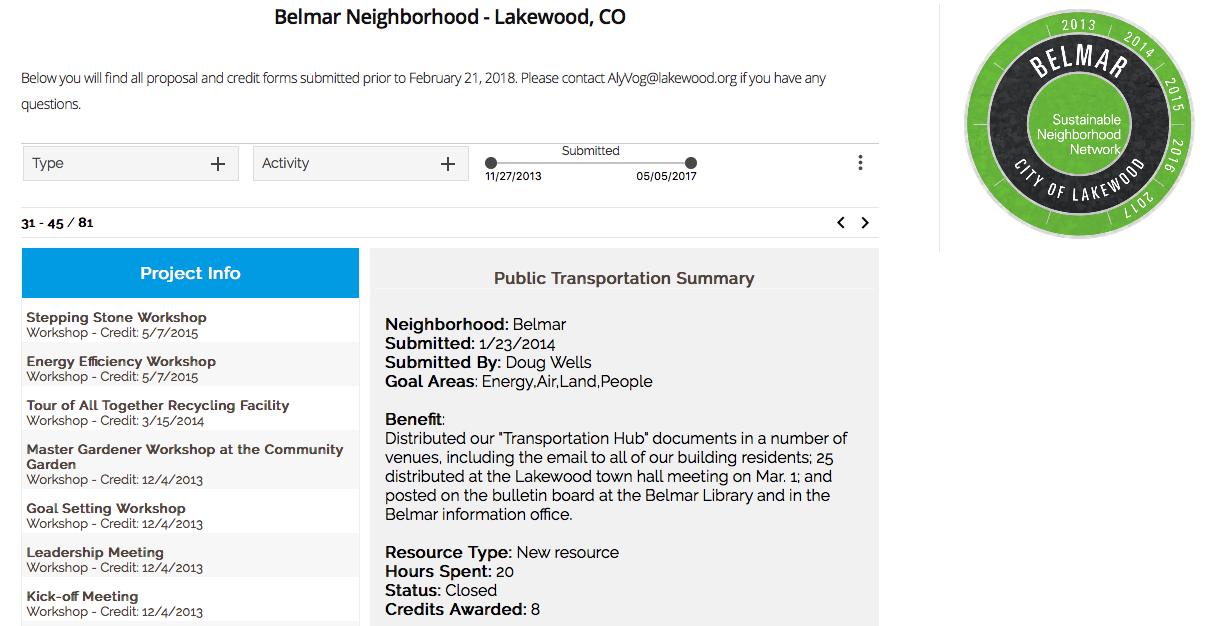
Figure 1: Screenshot from the Sustainable Neighborhood Network website depicting project status and summaries (Source: https://www.sustainableneighborhoodnetwork.org/sustainable-neighborhoods-lakewood/belmar/belmar-archived-forms)
Participating neighborhoods are recognized through celebratory receptions with the Mayor, the city’s newsletter and speaking opportunities for neighborhood leaders at schools, colleges, and professional conferences. The program’s contributions to the city’s sustainability goals are recorded in an annual report. The city also offers support for neighborhoods to “relaunch” the program when neighborhoods want to refocus their efforts and renew their leadership.
Why It Works
The success of the Sustainable Neighborhoods Program can be attributed to:
Read more about the impact and current status of the Sustainable Neighbhorhoods Program here [Updated March 4, 2021].
