
Problem Solved
Cases in this category focus on how CI has been used to accelerate problem solving in a specific domain.
CI How-to
Cases in this category highlight one specific design decision.
Task Performed
Cases in this category focus on a specific type of task 'the crowd' performs.
Kind of Collaboration
Cases in this category illustrate a specific kind of group work -- crowdsourcing, collaboration or co-design.
Level of Institutionalization
Cases in this category illustrate a specific level or type of institutionalization -- low to high and 'viral' (achieved success at scale).
Project website
Name: Safecast
Topic: Radiation and Air Quality Monitoring
Location: Global
Implementation Level: International
Owner: Safecast, a nonprofit organization based in Japan and the United States
Years in operation: 2011 - present
Platforms: safecast.org
Contact Information: Sean Bonner, Co-Founder and Director of Global Operations, Safecast
Contact Email: via [email protected]
Angela Eaton, Americas Director, Safecast via [email protected]
CASE STUDY LAST UPDATED: October 2020
Introduction
Every year since 1900, the National Audubon Society in the United States sponsors a Christmas time “bird count.” Thousands of volunteers participate in this annual bird census, which records information on local bird populations to inform conservation efforts.1 It is one of countless examples of laypersons participating in scientific research known as citizen science. Citizen science typically refers to scientific tasks, such as data collection, measurement, and classification, undertaken collaboratively either online or off between volunteer members of the general public and professional scientists. Citizen science makes use of the enthusiasm and willingness of ordinary people to participate in measuring air or water quality in their communities, cataloging flora and fauna in museums, or analyzing satellite photographs and making maps after a natural disaster.2 But what began in scientific circles as a way to use collective intelligence and collective action to accelerate research has also become a vital tool for governing. Laypersons can often do more than government can do alone – sometimes more than government will do – to gather and share important data, allowing everyone to have the more granular understanding of on-the-ground conditions needed for responsive policymaking and service delivery. Thus, where the government in Japan was not providing needed information after the Fukushima nuclear plant disaster, the activists from Safecast took it upon themselves to fill the gap, creating one of the most important, sustained and vigorous citizen science initiatives of all time and proving that ordinary people and communities are just as good as government or universities at collecting data. Nine years on, Safecast has grown from a disaster response effort following a crisis to an ongoing global environmental monitoring network.
How It All Started
On March 11, 2011, a 9.0 Mw earthquake, the most powerful earthquake ever recorded in Japan, unleashed a powerful tsunami and 19,000 people died. Sensors at the nuclear power plant at Fukushima in northeastern Japan detected the shock waves from the earthquake and automatically shut down the reactors. Due to flooding from the tsunami and a series of resulting malfunctions, the generators powering the systems that cooled the reactors stopped working, leading to three nuclear meltdowns, three hydrogen explosions and widespread nuclear contamination. An estimated 160,000 people were displaced from their homes. It was the worst nuclear disaster since the 1986 Chernobyl disaster.
In the aftermath, residents worried about contamination levels. Artist and entrepreneur Sean Bonner, who was living in Los Angeles at the time, had deep ties to Japan, where he had been regularly visiting and now lives since 2017.
When the disaster struck, he reached out to friends, including the very influential and connected Joi Ito, former director of the MIT Media Lab, but there was no clear information about what was going on.3 Everyone was panicked. Coincidentally, Bonner was scheduled to hold an event for the first week of April about what’s new on the Internet. Joi and Sean connected online with their network of friends via Skype chat to discuss whether it was safe to come to Japan and that morphed into a discussion about: What do we do next in Japan? What does recovery look like? As Bonner explains. “We started discussing how the little bit of data we could get was really just ‘giant averages’ … but even with devices we had, readings would change in a matter of footsteps and was not granular enough.”4
The public did not trust the accuracy or comprehensiveness of government published information. There seemed to be discrepancies between radiation readings and which neighborhoods the government chose to evacuate. In fact, it was five days before any official data came out of Fukushima after the disaster and the government’s sensor network was entirely offline for a month following the earthquake. What Geiger counters there were in-country quickly sold out.
The Collective Intelligence Process
How It Works
Following the meltdown, Sean’s friends – the original network that grew into Safecast – began to monitor, collect and openly publish data about radiation levels using handheld Geiger counters that, when they could not buy them, they built for themselves.5 Participants used a device to take readings and upload them. Data started to flow in. Because it was crowdsourced from many more people than the government had on the ground, the readings, which were taken at different heights, conducted street by street, with common devices and with greater frequency, were more granular and useful than what the government produced. Furthermore, because volunteers are collecting the data, there is intentional overlap with more than one person taking readings in the same place, which enables greater accuracy and accountability than a single official reading would.
To date, Safecast’s network of volunteers has collected more than 150 million measurements of radiation and air quality.6 Users can interact with this massive dataset through several online channels according to their technical ability. Each day, Safecast publishes a file containing all the radiation and air quality readings that users have uploaded to its database to date. More tech-savvy users can also filter the dataset and download only the readings they need, or upload their own data, using Safecast’s API.7 Anyone can easily explore Safecast’s data through the platform’s interactive web map, which shows hotspots of radiation and particulate matter (an indicator of poor air quality) around the world. Safecast also publishes this information through a mobile iOS application, which uses a user’s location to show radiation readings in their area in real-time.
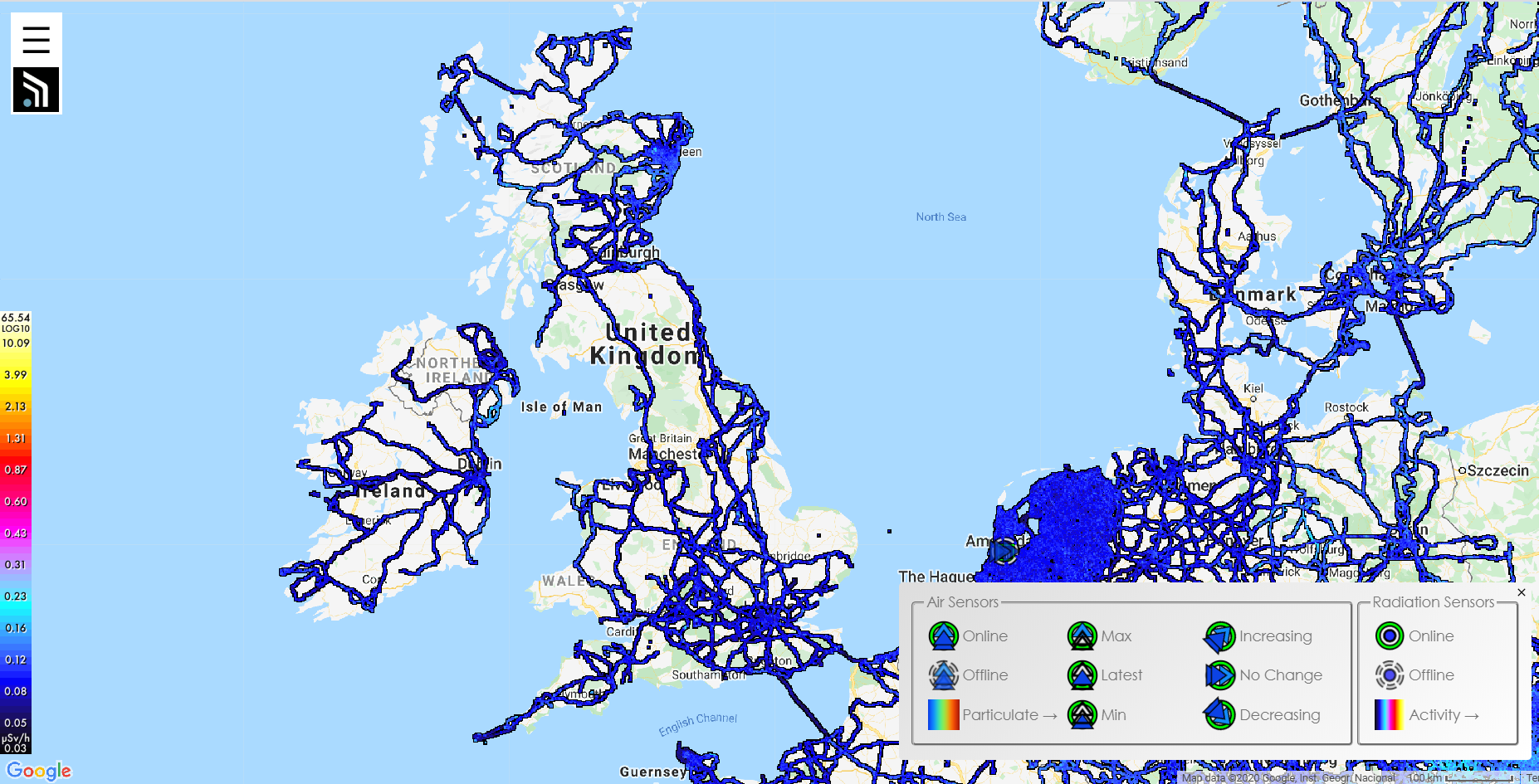 Figure 1: Safecast’s real-time map of air quality and radiation sensors, zoomed to the United Kingdom, https://map.safecast.org/?y=54.39&x=0.45&z=6&l=0&m=0
Who Participates?
Safecast exists because of the volunteer work of its committed participants, who collect the data but also build radiation monitors, develop the software to transmit and upload the data, including solar, weather-proof uplinks, offer sites to locate sensors, design the Safecast website and clean the data, which, in turn is made freely and openly available to governments, research scientists and activists to engage in distributed monitoring. Today with the advance of machine learning, researchers are using this historical data to predict future trends.
Foundations and individuals have funded the network’s efforts, such as the cost of building the sensors like handheld Geiger counters, which have been going for nine years now.8 As Sean Bonner writes: “A few hundred volunteers with Geiger counters built the largest radiation dataset ever amassed while politicians sat around talking about why they couldn’t do it. That’s the proof that a few committed people can do the work that everyone else will benefit from.”
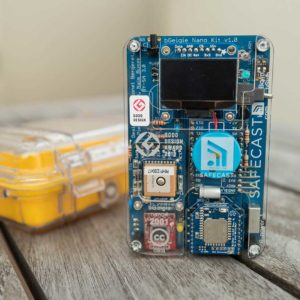
Figure 2: the bGeige Nano, a portable handheld Geiger Counter that is widely used by Safecast volunteers9 https://safecast.org/devices/ /
Current Status
Today, Safecast has expanded beyond Japan. Its volunteer network has mapped radiation data across most of Western Europe, the United States and Australia. They have data from over 100 countries, representing every continent. In fact, Safecast has supported the collection of over 150 million data points, making it the largest distributed data collection project in the world.10
As with other crowdsourcing projects like Wikipedia, the most active 10% of participants collect over 90% of the data, all of which is put in the public domain, allowing the data to be openly published and freely shared for re-use. This is in marked contrast, for example, to the United States where the government restricts radiation data and treats it as a national security risk to release.
The impact of the project, as with many “open” projects, which freely give away data, is hard to measure because those who use the data are under no obligation to credit Safecast or to report back to them. For example, one international report and recommendations on how to deal with nuclear crisis recommends exactly what Safecast does and even mentions Fukushima but does not mention Safecast by name.11 However, Sean Bonner writes: “I think the largest thing here is that the expectations of what is available have completely changed and researchers (and local politicians, and people) are demanding more than they used to be happy with.” France’s Institute for Radiological Protection and Nuclear Safety (IRSN) uses Safecast data on their own maps.12 The United States Defense Advanced Research Projects Agency (DARPA) has its own, closed version of Safecast where the public cannot see the data.13 Safecast leadership have spoken on several occasions before the International Atomic Energy Agency about the work.14
Beginning in 2016, Safecast expanded into measuring air quality data, again helping to construct the devices, set standards for how to measure, and offer the space to publish data to ensure transparency and consistency. Again, volunteer participants choose where to measure and take readings using approved sensors that they then share with the Safecast community. While radiation levels tend to be fairly static over time, air quality demands more frequent readings as it can change from day to day. Thus, many more monitoring sensors are needed. But with better air quality data, scientists, policymakers and individuals can assess how seasons, time of day, season, or temperature or other conditions impact the health of our air. As such, Safecast is working with partners like the Los Angeles public libraries to put monitors outside 23 of its buildings in LA and Pasadena at human height in public spaces to take the readings, enabling comparison across rich and poor neighborhoods. People can use the library to see and discuss the information and use it to guide their actions. The library serves as a convening point for engaging people in environmental monitoring and civic action.15
However, Safecast still faces myriad challenges imperiling its sustainability. While many governmental groups use their devices and data, outside of Japan there is limited collaboration with government and the network. Even in Japan, there is often a reluctance to credit Safecast for its efforts at the risk of embarrassing the government. But non-democratic governments (and you can see where they are from the gaps in Safecast’s mapping data), which do not encourage free speech, are less likely to collaborate with this citizen science effort. But the challenge is not only governmental. Many volunteers, drawn to the crisis response origins of Safecast are less interested in sustained engagement that involves developing solutions rather than gathering data alone.
Why Has Safecast Succeeded?
Whereas many civic engagement exercises have been one-off pilots, Safecast has enjoyed incomparable longevity for a variety of reasons.
