
Problem Solved
Cases in this category focus on how CI has been used to accelerate problem solving in a specific domain.
CI How-to
Cases in this category highlight one specific design decision.
Task Performed
Cases in this category focus on a specific type of task 'the crowd' performs.
Kind of Collaboration
Cases in this category illustrate a specific kind of group work -- crowdsourcing, collaboration or co-design.
Level of Institutionalization
Cases in this category illustrate a specific level or type of institutionalization -- low to high and 'viral' (achieved success at scale).
Project website
Name: Nuortenbudjetti: Helsinki’s Youth Budget
Topic: Participatory budgeting
Location: City of Helsinki, Finland
Implementation Level: city
Owner: Culture & Leisure Division, City of Helsinki Youth Services
Years in operation: 2013 - PRESENT
Platforms: Decidim
Contact Information: ,
Contact Email: [email protected]
CASE STUDY LAST UPDATED: 11/29/2022
This case study is part of a series on Youth Democracy. Click to find the others on Creamos: Co-creating youth-led social innovation projects in Chile and Forum Jove BCN: Barcelona’s Youth Forum.
Introduction
In the city of Helsinki, many young people want to work over the summer, but face difficulties securing temporary employment. In 2019, the city’s Youth Services unit implemented a Summer Job Voucher program, where the city gives €325 to companies that recruit teens for summer jobs. The program creates an incentive for companies to hire youth, and makes it easier for young people to find summer positions. Hundreds of companies participate in the program every summer.
The Summer Job Voucher initiative was a proposal originally made for kids by kids as it was proposed and developed through Helsinki’s youth participatory budgeting platform, Nuortenbudjetti.
Nuortenbudjetti (“Youth Budget” in English) is a youth participatory budgeting platform set up within Helsinki’s Youth Services (the unit responsible for work and policies related to impacting youth in the City of Helsinki). Both the platform and the process offer an excellent model for other cities and public institutions wishing to incorporate young people into public decisionmaking and create a more inclusive, participatory democracy.
Nuortenbudjetti is a five-stage, collaborative process in which young people submit ideas for youth-led projects, refine those ideas through workshops, vote on the ideas of others, design implementation plans, and ultimately put their ideas into action. The goal of this participatory model is to inform how the budget of each unit within the City’s youth services is allocated by using the input of thousands of young people every year.1 Since its inception in 2013, the model has allowed young people, ages 12-17, to share ideas for hobby opportunities, leisure time activities, and services for youth as well as for the entire city.2
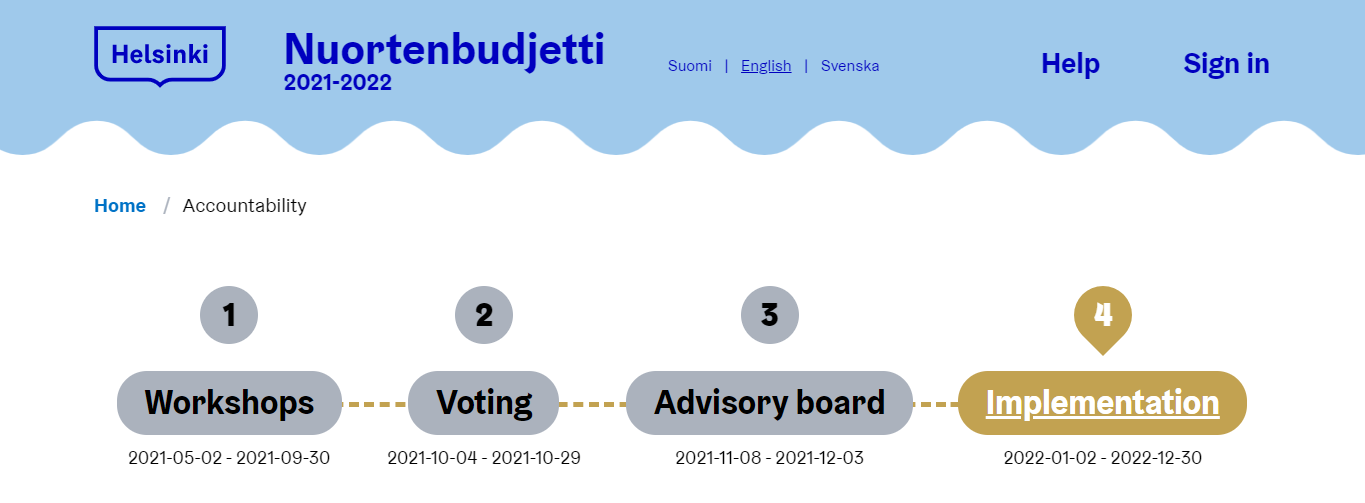
Fig 1: A screenshot showing the phases of the participatory budgeting process3
How Does it Work?
Nuortenbudjetti is a participatory budgeting model that empowers young people to co-design and co-implement projects with the support of Helsinki’s youth services units. Helsinki’s youth units, and their service workers are responsible for managing youth policy and youth work throughout Helsinki. The core group of people targeted by these units are young people aged 10-18 years old. There are 15 different youth work units in the city, and each young person falls under a unit based on where they live. Each unit independently facilitates culture-related extracurricular activities and services, provides support and guidance to the youth, and promotes their participation in society.4 Although all units share a common structure and schedule, each youth budget cycle is local, and each unit has its own separate budget.5 Therefore, each unit also has some flexibility to adapt the five stages of Nuortenbudjetti process as needed to fit the desires and needs of their community.
The five stages involved in the Nuortenbudjetti process are:
Every spring, Nuortenbudjetti’s youth service units begin to obtain information about the hopes, concerns and ideas of young people. They gather this information using surveys and school outreach events that change each year according to a set of thematic questions. Much of the information gathered is from young people at schools, and often organized by grade.6 This stage sees the largest number of participants within the participatory budgeting process.
At the onset of the COVID-19 pandemic, information gathering moved online. In 2022, the project’s leaders are planning a hybrid information gathering model. In some cases, information will be gathered through in-person events, for instance, at schools.
Nuortenbudjetti’s organizers are also experimenting with artificial intelligence (AI) for sentiment analysis during the program's information gathering stage. In 2022 they are working with Etuma, a text analysis service, to group responses to the open-ended survey questions and draw insights to identify common themes in the survey responses. Youth workers will then work with participants to help them develop proposals around the popular themes in their neighborhood. “For example if the youngsters in certain areas say that they lack opportunities for outdoor sports, the participants in the workshop might decide to develop a proposal tackling this issue,” Johanna Laukkanen, a planner at Helsinki’s Youth Services, told us.7
Between May and September, workshops are held where young people analyze the information that has been gathered within their different areas. Youth workers and participants then work together to group and highlight materials and eventually to develop young people’s ideas into implementable plans with cost estimates.
During this stage, Borough Liaisons–individuals appointed by each district to act as a bridge between the city government and residents–engage residents in their districts and provide information about how they can partake in the participatory budgeting process.8
Some of the plans developed at this stage are further refined and implemented through Helsinki’s young people’s initiative system, rather than through the participatory budgeting process.6 The initiatives system is a separate process that allows people ages 13-17 in Helsinki to bring forth ideas that they would like to present to the City Council, and to refine these ideas with the input of civil servants.10
During the Voting stage, young people vote on which proposals developed in the workshops they would like to see implemented. The Voting phase takes place in October and lasts for approximately one month.
Prior to the COVID-19 pandemic, voting areas were local, and were located in each of Helsinki’s 15 districts. Each participating youth was required to visit a voting site in their residing district in order to cast their votes. However, since 2020 online voting through the Nuortenbudjetti website, has become and will remain a permanent feature of the program.
With the use of their Wilma credentials (a web interface used in Helsinki schools that allows students and guardians to keep track of their studies) students vote on the developed plans. Those aged 12-17, who are not enrolled in a school, vote through local Youth Centers.6 Each participant has three votes (i.e. they can vote to support up to three ideas), and can decide to use some, all, or none of their votes during the voting stage.1 The platform uses Decidim, a digital platform for facilitating citizen participation, to facilitate the voting process.
In November and December, Nuortenbudjetti’s advisory board meets to evaluate the proposals and decide which will receive funding from the City to be implemented. The advisory board is made up of a Local Youth Work Manager, young people from the area, specialists concerning Nuortenbudjetti’s plans within an area, as well as decision makers. They evaluate what has been decided upon based on votes, and then confirm the voting results for different districts. Then, they select the proposals/plans that will be implemented.
Plans that cost less than €3,000 can be implemented through the existing budget allocated to each youth work unit. To implement more expensive plans, individuals can apply for funding from RuutiBudjetti’s €150,000 reserve. Most plans that make it to the implementation stage have budgets that range from €500-20,000.1
Plans are implemented throughout the following year (in other words, plans suggested and voted on in 2021 are implemented in 2022). At this stage, plans that have been selected for implementation by the advisory board, unless otherwise agreed upon, are then implemented during the subsequent budget year.1
In 2021, young people developed 120 proposals, 64 of which went through to the implementation stage. As of May 2022, most of these 64 proposals are still in the planning phase. An example of a project that will be implemented in 2022 is a Halloween walk for the young people in the city. Another example of a project that made it through to the implementation stage is the creation of a free after-school club, which will allow young people to engage in leisure activities such as craftwork, and playing chess after school.
Who Participates?
Participation in Nuortenbudjetti, primarily, is open to young people in Helsinki in grades 6-9. As a means of identification, students in these grades use their Wilma credentials to participate. Young people who are not enrolled in school are still able to participate in Nuortenbudjetti through local Youth Centers.10
The program has facilitated the participation of thousands of young people in Helsinki each year. In 2021, more than 7,000 young people participated, which reflected 30-40% of 13-17 year olds in the city. In total, the platform has garnered the participation of more than 14,000 young people in Helsinki. However, due to limited resources for outreach, participation has been limited to native Finnish speakers for the most part. This makes it challenging to engage diverse members of Helsinki’s youth population, including non-native speakers and immigrants.
Outcomes and Impacts
While exact figures of the number of projects from the platform’s early years are not available, the City reports that, in recent years, young people across Helsinki develop roughly 120-160 proposals which are voted on annually. Approximately two-thirds of these proposals reach the implementation stage.5
The Summer Job Voucher program, discussed above, is one example of an impactful project. Hundreds of companies now participate in this initiative each year. The city reports that more than 2,400 young people were employed through the voucher scheme in 2021.11
Ms. Laukkanen notes that, while it is difficult to measure the full scope of Nuortenbudjetti’s impact, the participatory budgeting model has helped certain services within the city government see the value of engaging young people.11 She notes that the model comes with the promise: “when you take part, we promise you that you will have a say.” Ms. Laukkanen also noted that many young people have expressed growing interest in having a greater role in planning and delivering the budgeting process . To that end, in future years Nuortenbudjetti’s team is hoping to create more opportunities for youth, as well as non-profit organizations, activist groups, and other groups outside of the City government, to participate in certain aspects of the program’s design and delivery.
Lessons Learned
1. See https://nuortenbudjetti.hel.fi/?locale=en
2. Prior to 2022, the platform was known as Ruutibudjetti, but its name was changed after a new model for youth participation in Helsinki was approved by Helsinki’s City Council in February 2022 following an evaluation of the previous “Ruutibudjetti” model. Under the new branding scheme, the City of Helsinki brands each youth participation program rather than using an longer uses an “umbrella brand” to highlight youth participation across the city.
3. See https://nuortenbudjetti.hel.fi/processes/ruuti-2021/f/190?locale=en
4. “Youth Unit,” City of Helsinki, Accessed June 30, 2022. https://www.hel.fi/kulttuurin-ja-vapaa-ajan-toimiala/en/about_us/youth_division/#:~:text=The%20Youth%20unit%20is%20responsible,approximately%2050%20facilities%20around%20Helsinki.
5. Email correspondence with Ms. Johanna Laukannen, Planner, Helsinki’s Youth Services.
6. “How does the youth budget work?” City of Helsinki, Accessed June 30, 2022. https://nuortenbudjetti.hel.fi/pages/miten-ruutibudjetti-etenee?locale=en
7. Interview with Ms. Johanna Laukannen, Planner, Helsinki’s Youth Services
8. “Borough Liaisons in City Districts,” City of Helsinki. https://www.hel.fi/helsinki/en/administration/participate/channels/participation-model/borough-liaisons/
9. The initiative system is a four phase process: 1) Submitting an initiative: Individuals submit their initiatives to the City of Helsinki using the youth initiative system. 2) Processing of the initiative: Submitted initiatives are then directed to a city service worker within its processing division. This service worker helps the young people who submit initiatives to develop their ideas. 3) Reply to the initiative: After each initiative has been developed, their authors then receive an email from either the mayor or deputy mayor of Helsinki. This email highlights any procedures that were taken by the city in response to the initiatives. They are also published on the Nuortenbudjetti website. 4) Processing by the City Council: In this phase, Helsinki’s City Council processes the initiatives, and this is done twice a year. At this stage, progress can be tracked through the Helsinki Channel, which offers broadcasts and publishes recordings pertaining to Helsinki City Council meetings, concerts by the Helsinki Philharmonic Orchestra, as well as resident evenings hosted by the mayor of the city. For more information, see: https://nuorten.helsinki/en/take-part-and-make-a-difference/young-peoples-initiatives/
10. “Who can participate in the Youth Budget?” City of Helsinki. https://nuortenbudjetti.hel.fi/pages/kenelleruutibudjetti?locale=en
11. “Helsinki’s Summer Jobs Voucher for More Young People This Year.” City of Helsinki, February 18, 2022. https://www.hel.fi/uutiset/en/kulttuurin-ja-vapaa-ajan-toimiala/summer-job-voucher-for-more-young-people-this-year
