
Problem Solved
Cases in this category focus on how CI has been used to accelerate problem solving in a specific domain.
CI How-to
Cases in this category highlight one specific design decision.
Task Performed
Cases in this category focus on a specific type of task 'the crowd' performs.
Kind of Collaboration
Cases in this category illustrate a specific kind of group work -- crowdsourcing, collaboration or co-design.
Level of Institutionalization
Cases in this category illustrate a specific level or type of institutionalization -- low to high and 'viral' (achieved success at scale).
Project website
Name: New Start Career Network
Topic: Workforce Development
Location: New Jersey, United States
Implementation Level: State Government
Owner: John J. Heldrich Center for Workforce Development (Rutgers, The State University of New Jersey)
Years in operation: 2015 - present
Platforms: Web; phone; in-person
Contact Information: ,
Contact Email:
For more information, contact [email protected]
CASE STUDY LAST UPDATED: October 2020
Despite the unemployment rate in the United States reaching a 50-year low in 2019, long-term unemployment - where people are unemployed for over six months - remains a major issue.1 Long term unemployed job seekers are more likely to remain unemployed and to suffer depression and anxiety. Even those who are re-employed after a stretch of long-term unemployment may end up underemployed, or in roles that underutilize their skills or education, and are often paid less than they were earning previously. Needing to work -- and not being able to find a full-time job -- some end up in multiple part-time jobs to make ends meet.
Since the global financial crisis, older, more experienced, and often well-educated people are joining the ranks of the long-term unemployed. People in this older cohort (age 45+) face unique barriers to finding a job. In addition to the financial and emotional challenges that can accompany long-term unemployment, older workers often have outdated job search skills and encounter age discrimination when applying for new jobs.2 Moreover, there are fewer services catering for this demographic, with the limited programs there are typically focused on helping people win entry level jobs or designed for other categories of unemployed job seekers such as the justice-involved, veterans or those with disabilities, who may face daunting but different challenges.
In New Jersey, which has had one of the highest rates of long-term unemployment in the US and where about half of the state’s long-term unemployed are over age 45, researchers have begun exploring ways to support this group of older job seekers.3 Since 2015, the Heidrich Center for Workforce Development at Rutgers University, one of the nation’s leading action research organizations focused on workforce, has developed a live and web-based coaching program - the New Start Career Network (NSCN) - to provide free assistance to long-term unemployed and underemployed job seekers aged 45 and older.
At the core of New Start’s offering are volunteer career coaches who, over a 3-month period, help job seeker “members” of the network to develop career plans and find job opportunities. Coaches also connect job seekers to services that help people to manage their finances and mental health, learn about education and training opportunities, or access resources of partner organizations. Coaching is delivered primarily by phone and free, web-based video conferencing tools (such as Zoom) and complemented by in-person sessions. By using a web-based platform the NSCN is able to assemble the widely distributed expertise of volunteer coaches and match it to the specific needs of older job seekers. The NSCN also gives members access to a collection of online career planning resources. Maria Heidkamp, Director, New Start Career Network, explains this was a vast improvement on what was previously available:
There were some bootcamp model programs that put long-term unemployed jobseekers through a 5-6 week bootcamp. These were very intensive and had a high cost per job seeker but they could only serve 20-25 people at a time. When we started, New Jersey had about 125,000 people in this category - long-term unemployed...and given our resources, we needed to figure out how we could use technology to build some way to provide services, at scale, but also provide handholding for people who need that. In other words a combination of ‘high tech and high touch’.4
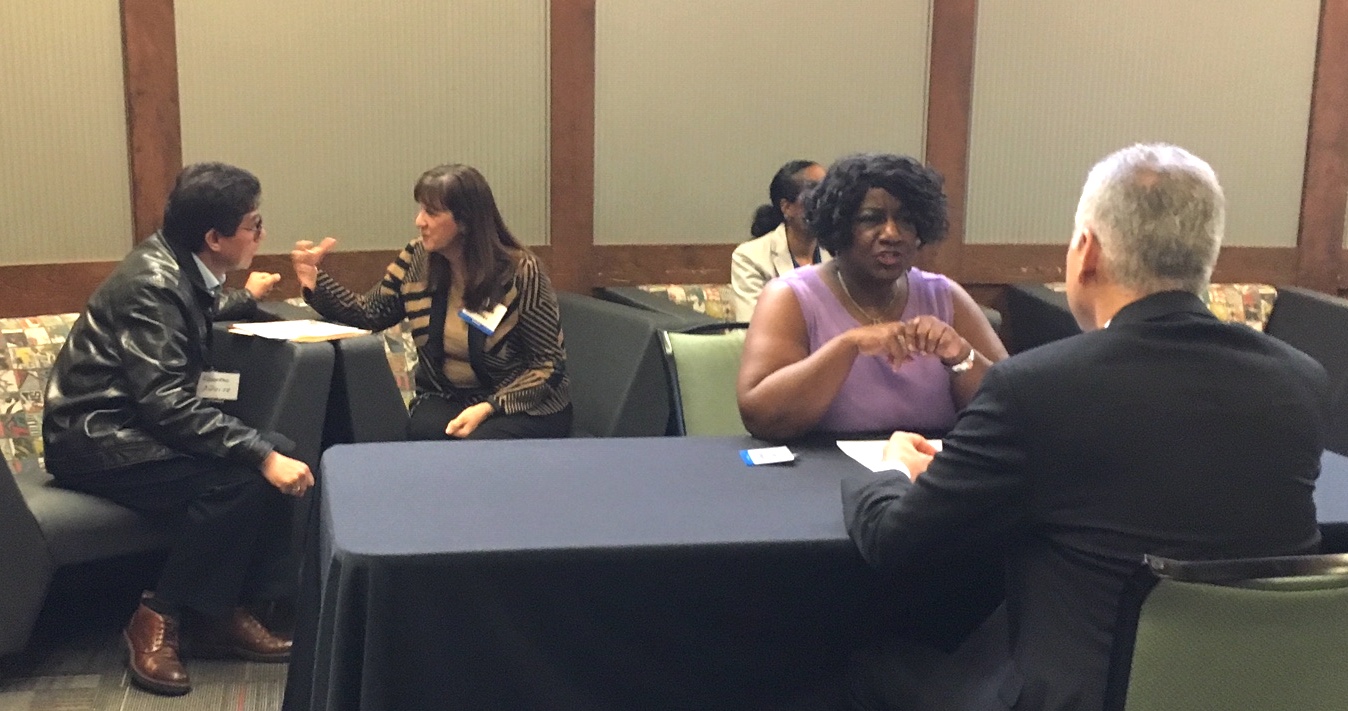
Figure 1: A New Start Career Network Job Fair where volunteer career coaches are helping job seekers in “Practice your pitch” sessions (Credit: John J. Heldrich Center for Workforce Development).
The result? As of January 2020, the NSCN has 5,100 registered members and 330 volunteer career coaches, with 689 members receiving individual coaching over the first four years of the program. In a 2018 survey of members, two-thirds indicated that the NSCN had improved their motivation, half said it had improved their confidence and emotional well-being, and 86 percent said they would refer the program to a friend.5 In the words of one job seeker, “It was good to have someone to check in with, to help me come up with goals and actionable items, and to keep me accountable. It’s also good to know you’re not alone.” Another noted, “My coach listened and offered guidance and advice and was always there for me if I needed support, or even just to bounce ideas and thoughts around with.”
The educational profile of NSCN members also supports the contention that a cohort-specific response for older, more educated job seekers is needed, with 44 percent of members holding a bachelor’s degree and 33 percent holding a Master’s degree or higher. The program is open to all job seekers, however, including those with high school degrees or less. The Heidrich Center is currently conducting an analysis to assess the NSCN’s effect on employment outcomes with results expected to be available later in 2020.
Volunteer coaches recruited to the program bring diverse professional backgrounds, valuable personal experiences, and are geographically dispersed. This enables NSCN to better match a coach’s capabilities with an individual job seeker’s needs and ambitions. For example, some coaches are HR professionals, others are industry experts from IT, finance, healthcare, pharma, education and other sectors. In one case, NSCN matched a volunteer coach with a background in international marketing with a job seeker who was trying to get back into import/export and logistics and distribution work. In another case, a volunteer coach who holds an MBA in finance has worked with several job seekers seeking related positions. Some job seekers are seeking a coach who will be task-oriented and help keep them accountable; others are hoping for help exploring alternative career possibilities. In addition to their professional backgrounds, many of the volunteers have either dealt with job loss themselves or have experience in interacting with people who are long-term unemployed. With coaches located across North, Central and South Jersey, and a handful from New York and Philadelphia, matches between coaches and job seekers from the same or nearby communities can also be achieved. Job seekers are given a choice of virtual or in-person coaching, with the caveat that virtual coaching makes it much easier to make a match.
In 2018, in recognition of their extraordinary volunteer efforts to help New Jersey’s long-term unemployed job seekers, the NSCN Volunteer Career Coaches were honored with a NJ State Governor’s Jefferson Award. The Jefferson Awards were established in 1972 as the official recognition program of the United States Senate and are considered America’s highest honor for public service and volunteerism. In NSCN’s first four years, the coaches collectively donated over 40,000 hours to helping job seekers.
The NSCN has also attracted a wide range of collaborators from the government, business and community sectors who support and advocate for older job seekers. A major partner is Rutgers University Career Services, which has provided access to several online tools such as Vault and Sokanu and assists with employer recruitment for NSCN’s fall and spring members-only job fairs. There are various employer, industry or business association partners that often help promote or participate in NSCN’s job fairs or post jobs on the website or in the Tip of the Week email blast. Government partners in New Jersey include the Department of Labor and Workforce Development, Governor’s Office of Volunteerism, which provides financial support to NSCN through a federal Volunteer Generation Fund grant, Community College Consortium and both the State Library and the NJ Library Association. Community partners include the Mental Health Association of New Jersey, job clubs, older adult service and advocacy organizations, and veterans employment programs.
Key staff at the Heidrich Center involved with NSCN have also helped to shape government workforce development policy through their participation on the advisory council for New Jersey’s jobs strategy. Launched in January 2020, Jobs NJ recognizes the unemployed, underemployed and those out of the labor market as “underutilized talent pools” that offer opportunities to strengthen the state’s competitive advantage in talent.6
How does it work?
Job seekers have learned about NSCN through several sources including newspaper and radio coverage when the program was launched, word-of-mouth, through presentations at job clubs and libraries, and referrals from partners and other programs including from One Stop Career Centers. All job seekers sign up on the website; in a few cases, public libraries have assisted job seekers who have limited computer skills.
At the sign up page job seekers are asked to verify their eligibility to become a member of the NSCN by confirming their state of residence (must be a resident of New Jersey) and birth year (must be 45 years of age or over). Once eligibility is confirmed a short series of questions gathers information about the job seeker’s unemployment benefit status, highest level of education, recent work history, and internet access, all of which is used to personalize the support members receive.
Upon logging in, job seeker members can access online support such as:
Job seekers who opt to work with a volunteer career coach are matched with a coach based on several factors including whether they are open to virtual instead of in-person coaching, industry background (where possible), and whether they need help with specific tasks (such as improving their LinkedIn profile) or more general assistance with accountability and motivation. Volunteer coaches are asked to commit to 2-4 hours a week for 6 months, although many of the volunteers have continued with NSCN for one or more years. Before starting as a coach, they must complete a 6-hour in-person orientation and training session, which includes information about the labor market, the professional and personal challenges older and long-term unemployed job seekers face, such as age discrimination and lack of self esteem and confidence, and an overview of contemporary job search and basic coaching techniques. Coaches are recruited through the Rutgers University Alumni Associations, human resources professional associations, community partners, and through a standing call on the NSCN website.7 The NSCN also has an online Coaching Community of Practice that helps to build the capability of all coaches.
NSCN coaches have experimented with a variety of small group virtual coaching sessions focused on resilience, keeping positive during a job search, pursuing entrepreneurship, coping with transitions, and mens’ and womens’ groups.
Major funding for the NSCN is supplied by the Philip and Tammy Murphy Family Foundation, with additional support from a range of business and community organizations including New Jersey Resources, the Fund for New Jersey, and the Corporation for National and Community Service/New Jersey Volunteer Generation Fund.
Why It Works
