
Problem Solved
Cases in this category focus on how CI has been used to accelerate problem solving in a specific domain.
CI How-to
Cases in this category highlight one specific design decision.
Task Performed
Cases in this category focus on a specific type of task 'the crowd' performs.
Kind of Collaboration
Cases in this category illustrate a specific kind of group work -- crowdsourcing, collaboration or co-design.
Level of Institutionalization
Cases in this category illustrate a specific level or type of institutionalization -- low to high and 'viral' (achieved success at scale).
Project website
Name: Decidim Helsinki
Topic: City Development
Location: Helsinki, Finland
Implementation Level: city
Owner: City of Helsinki
Years in operation: 2018-2019
Platforms: Decidim; in-person
Contact Information: Katja Henttonen, e-Democracy Platform Project Manager for the City of Helsinki
Contact Email: via [email protected]
https://omastadi.hel.fi/pages/yhteystiedot?locale=en
CASE STUDY LAST UPDATED: October 2020
Since participatory budgeting (PB) was first introduced in the City of Porto Alegre, Brazil in 1989, hundreds of cities around the world have allocated a portion of their budget through citizen deliberation. Helsinki began the first trial of its citywide participatory budgeting program in 2018. Helsinki’s approach combined online proposal creation and voting, using the Decidim platform, with an offline strategy for outreach and deliberation. Anyone could propose small-scale projects that fell within the city’s jurisdiction, while residents of Helsinki age 12 and over were eligible to vote on which to implement. Over the course of a month, participants submitted 1,273 proposals for how to allocate a budget of €4.4 million towards small-scale projects within their neighborhoods. At the end of the process in October of 2019, the city approved 44 project plans for implementation. While many cities use participatory budgeting, some with budgets vastly exceeding that of Helsinki, the Finnish capital is a useful example of how to use PB both to prioritize capital improvements but also to foster civic engagement. The City went to great lengths to engage with residents and make PB a highly participatory and collaborative process. The model has been so successful that, after an initial pilot the City has formalized the use of PB as a regular part of city life.
Background
Upon taking office in 2017, Helsinki’s mayor and city council began a series of structural changes to make the city’s government more responsive to the public. Participatory budgeting was implemented in Helsinki in 2018 as part of this larger overhaul.
To ready the city for the participatory budgeting process, the City Council made a decision to split the funds between seven boroughs. Over a one month period, residents could propose ideas online for projects either at the city level or that fell within the borough in which they lived. Further, the city hired seven “borough liaisons”-- civil servants hired to increase civic participation within their neighborhoods and provide information about PB. As part of the offline outreach effort, the city worked with a local design firm to develop a card game to help users understand the PB process and come up with ideas for projects. The game centers around six different kinds of playing cards, each corresponding to one aspect of the PB process (e.g. limiting factors, citizen personas, city districts) tailored to spark conversation among players and help them develop ideas for funding. The card game was played by hundreds of people at workshops where physical (and digital) copies were also distributed for free.1
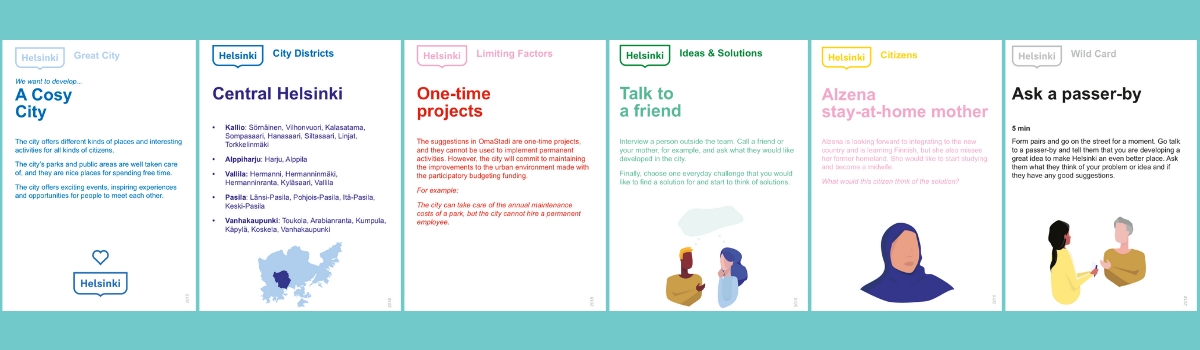
Figure 1: The OmaStadi Participation Game (Source: https://medium.com/@BloombergCities/how-a-card-game-can-help-city-residents-suggest-new-ideas-b1da60bb112b )
“The game is a tool to make [Participatory Budgeting] approachable,” Kirsi Verkka, Development Manager at the City of Helsinki, told Bloomberg Cities. “Not something that feels complex or bureaucratic, but something where you can sit down with people, have a good time, and do something for your community.”2
The online portion of the PB process was conducted on OmaStadi.hel.fi. This website uses Decidim based on the Consul framework, a free and open source citizen engagement platform used by numerous city and regional governments and non-profit organizations.
The Result
The PB trial run, which began in 2018 and lasted through 2019 produced 1,273 ideas for funding, which over the course of a year were adapted into 296 project plans that were put to a vote. At the end of voting, the city approved 44 projects for implementation.3 The list of project plans and those approved for each district were published on the initiative’s results page. The winners ranged from a €120,000 plan to install more trees, benches, and trash cans throughout the city to a €50,000 plan to build a new basketball court in a central suburb.
Based on the success of the first round, the participatory budgeting process will now be formally included as part of the regular municipal budgeting process. “In general I hope this has raised awareness among the people to participate in talks about what happens in the city,” Kirsi Verkka told a local media outlet. “The essence of the whole project was that we would have an open discussion with citizens.”4
The city government also collected demographic data on votes to assess how votes varied by age, gender, and region. The city government sent out a survey to all the participants via email to which approximately 300 people responded. In an interview Katja Hentonnen, one of the leaders of the PB project, described the responses as positive overall, but did note that one of the most common complaints was that the budgeting process benefited wealthy areas, with many of the winning projects going to already wealthy regions.5
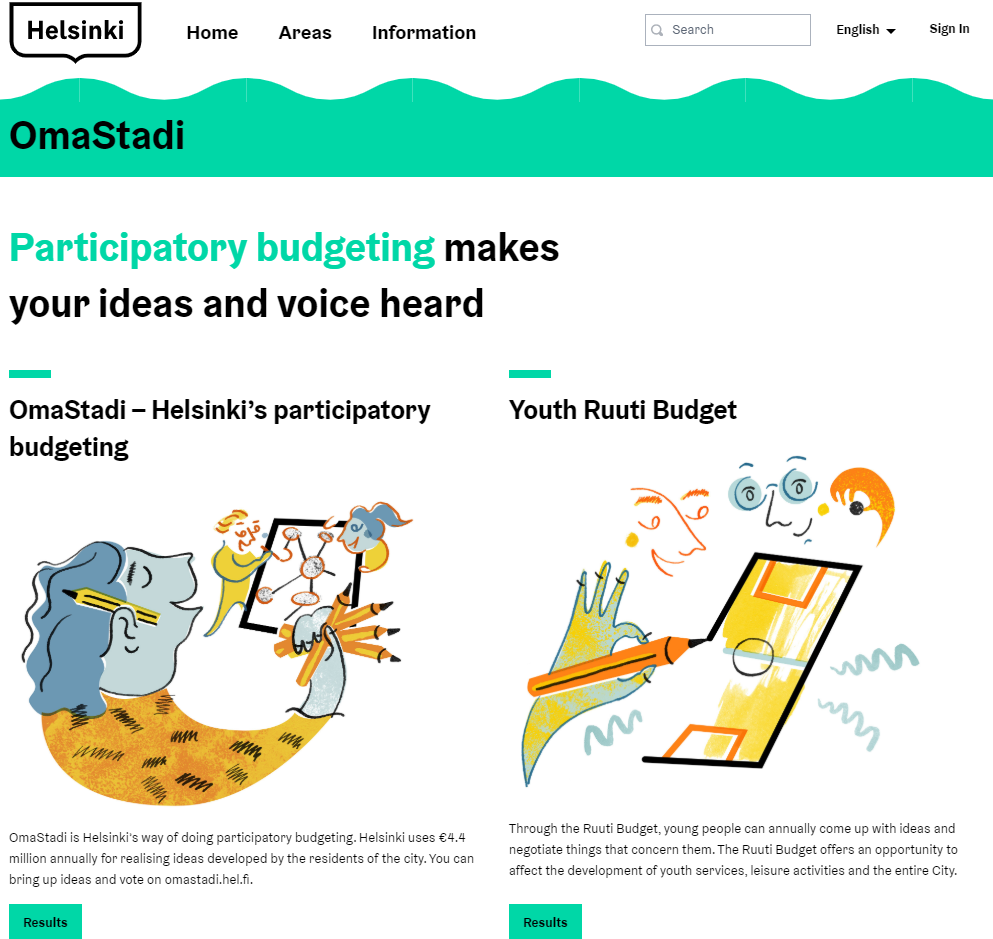
Figure 2: The OmaStadi website (Source: OmaStadi.hel.fi)
How it Worked
The participatory budgeting process was run over the course of a year through six steps:6
In May of 2018, the borough liaisons hosted a seminar to kick-off the participatory budgeting process. While some citizens attended in person, many others joined an online livestream, where they could comment on the proceedings in real-time, with comments shown on a large screen at the center of the stage. This event set the tone for the combined online-offline approach that would characterize the rest of the initiative.
In October and November of 2018, the public generated ideas for what to fund. Borough liaisons hosted a series of workshops where they explained the PB process, distributed the aforementioned card game, and answered questions about how to submit ideas on OmaStadi.hel.fi. The website was open for submission between mid-November and mid-December, during which time residents submitted 1,273 ideas. This included a range of proposals from improving the infrastructure of local parks, to creating new street art, to designing a scenic walking route through Helsinki. At the same time, representatives from the city’s divisions evaluated each idea against the city’s eligibility criteria. Each idea that was eliminated received a comment explaining why (e.g. it was not within the city’s jurisdiction to build). This resulted in 839 approved ideas.
From January - April, 2019, city officials and residents transformed eligible ideas into implementable plans that could be cost-estimated. This was done through a series of in-person workshops where citizens collaborated with borough liaisons to create a plan either out of a single idea or by combining similar ideas. Again, citizens then uploaded these plans to OmaStadi.hel.fi, where citizens and city officials could comment on them. City divisions were then responsible for preparing a cost estimate for each plan.
During the month of October, residents could vote on the plans that fell within one district of their choice or that were to be implemented at the city level. Any resident of Helsinki age 12 or older could vote online, or during events held at local libraries and community centers. For those aged 12 to 17, the platform also included a separate youth participatory budgeting project section called “Ruuti Budget” in which young people could raise ideas for development of youth and leisure services. The youth contingent was allotted €330,000 to allocate to youth-related activities.
In the pilot, a total of €4.4 million was available for funding, with one-fifth of this amount reserved for city-wide plans. The remaining pool of funding was divided between the seven boroughs. The winning projects were determined through a rolling system, where the top-scoring plan in each borough received funding. Funding was then allocated to the next highest-scoring plan that did not exceed the remaining budget, and so on until no plans remained.
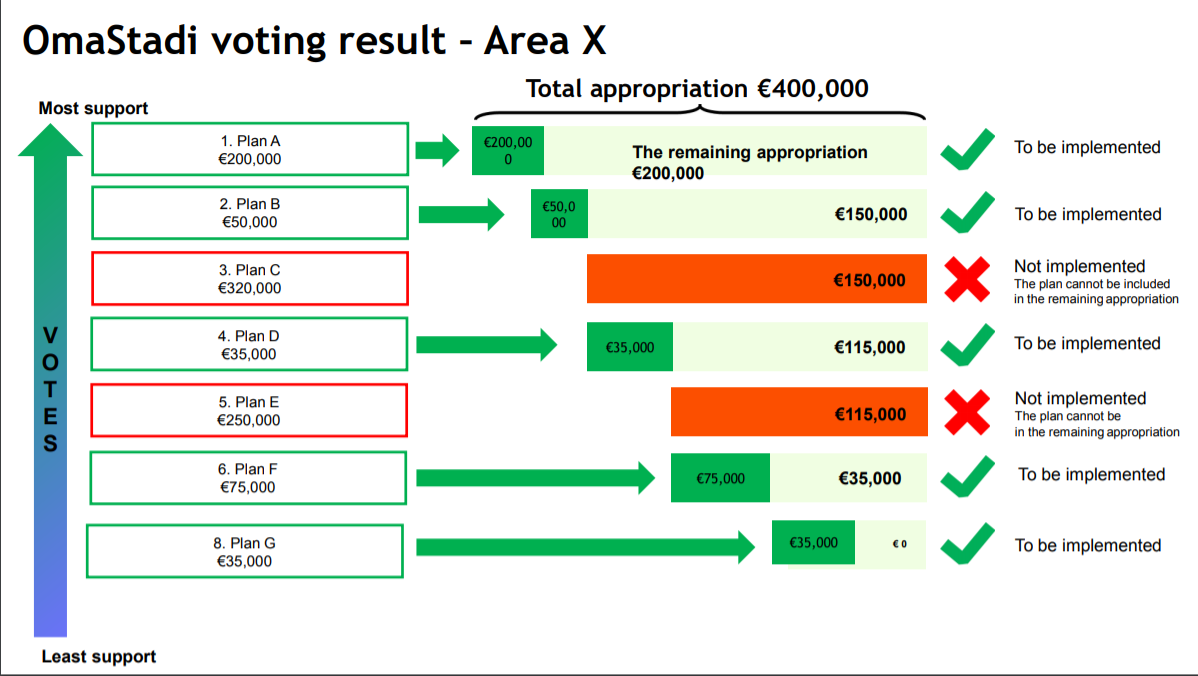
Figure 3: A visualization of the funding allocation process for a sample area (Source: https://omastadi.hel.fi/uploads/decidim/attachment/file/1927/%C3%84%C3%A4nestystulos_visualisointi_alusta_english.pdf / CC BY-SA 4.0)
Why It Worked
The success in the trial run of Decidim Helsinki can be attributed to:
